Original Version
Behind the song
"Alexander's Ragtime Band" is a song by American composer Irving Berlin released in 1911.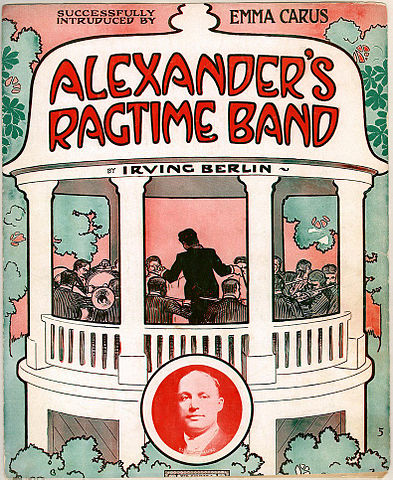
Irvin Berlin belonged to the Tin Pan Alley, a group of New York-centered music producers and composers who dominated American popular music during the late 19th and early 20th centuries.
The song could be considered a narrative sequel to "Alexander and His Clarinet", which Berlin wrote with Ted Snyder in 1910 and is primarily about a reconciliation between an African-American musician named Alexander Adams and his beloved Eliza Johnson, also highlighting the innovative musical style of Alexander.
Berlin's "Alexander's Ragtime Band" was presented to the American public by vaudeville comedian Emma Carus, "one of the great stars of the period." At the time of vaudeville she was known for her "low bass notes and high lung power."
The song comically recorded by the American duo Arthur Collins and Byron G. Harlan became the number one hit of 1911.
Nearly two decades later, jazz singer Bessie Smith recorded a 1927 version that became one of the hit songs of that year.
The song's popularity skyrocketed in the 1930s with a musical film of the same name starring Tyrone Power and Alice Faye.
She has performed with a variety of artists such as Al Jolson, Billy Murray, Louis Armstrong, Bing Crosby...
Fifty years after its release, the song had at least a dozen hit versions.
Great cultural success:
After its initial release, the happy Berlin tune "sold one million copies of scores in 1911, then another million in 1912, and continued to sell for years afterwards. It was the number one song from October 1911 to January 1912." Overnight, Berlin has become a musical and cultural landmark.
Later, Berlin was promoted as the "King of Ragtime" by the international press, an inaccurate title as the song "had little to do with ragtime and anything to do with the audacity of ragtime, alerting Europe to the turbulent times in the colonies."
Although not a traditional ragtime song, the positive international reception of "Alexander's Ragtime Band" in 1911 led to a
musical and dance renaissance known as "The Ragtime Craze". The Daily Press wrote in 1913: “In every restaurant, park, and
theater in London, the varieties [of Berlin] are heard; Paris dances with him; Vienna abandoned the waltz; Madrid threw away the
chestnuts and Venice forgot about the barcarolas ”. Ragtime swept the earth like a whirlwind.
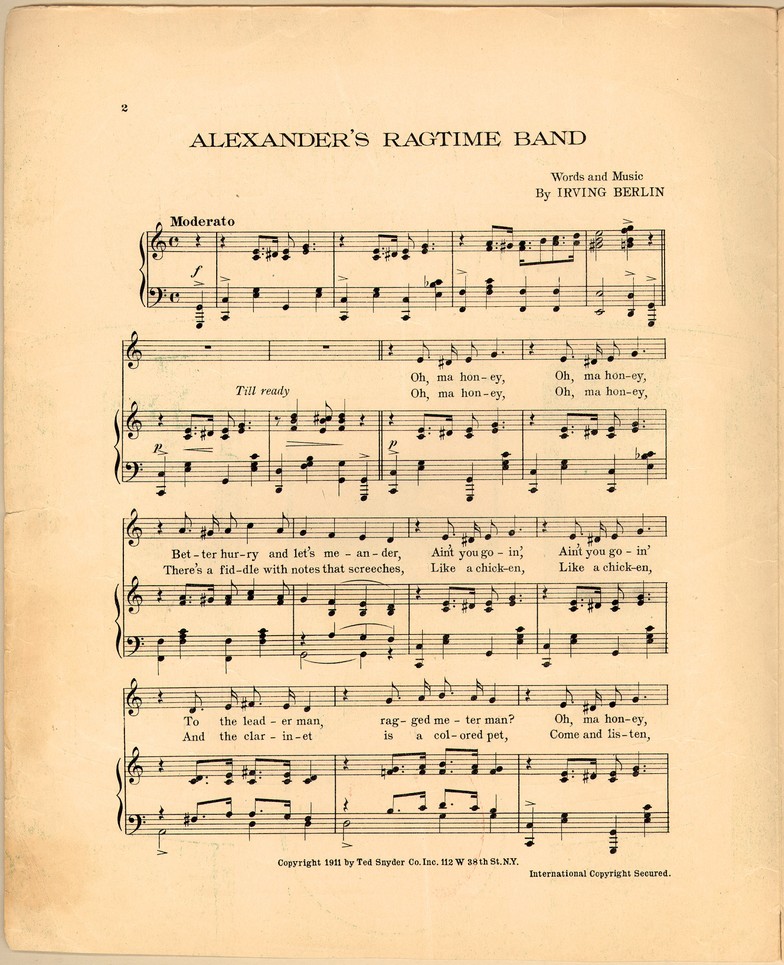
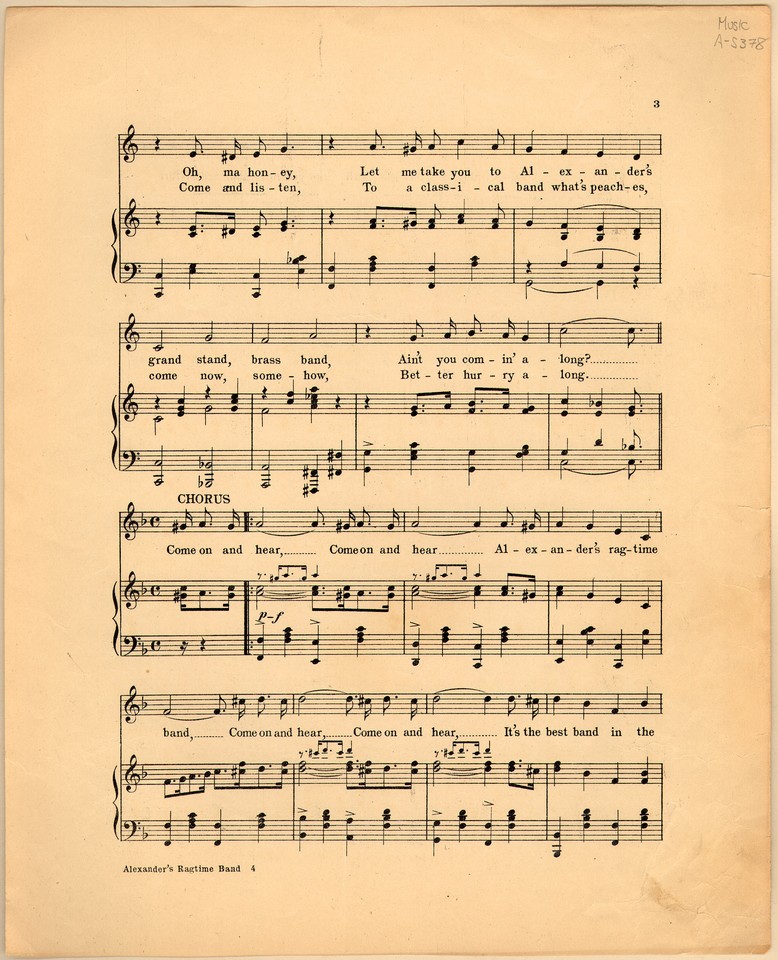


In 1937, 20th Century Fox approached Irving Berlin to write a story for an upcoming film provisionally titled Alexander's Ragtime Band. Berlin agreed to write a sketch of the story for the film which included twenty-six of his well-known musical scores. During press interviews promoting the film before its release, Berlin denounced articles in the American press that portrayed ragtime as "the forerunner of jazz." 'the father of jazz' because, "as everyone will say when they hear it, ragtime and jazz are the same."
Plagiarism allegations:
There are allegations that Berlin stole the "Alexander's Ragtime Band" tune (in particular, the four notes of "oh, ma honey") from the drafts of "Mayflower Rag" and "The Real Slow Drag" by prolific composer Scott Joplin.
Berlin and Joplin were known in New York, and Berlin had opportunities to hear Joplin's scores before publication. At the time, "one of Berlin's duties at the Ted Snyder Music Company was to look for other composers' publishable music."
Berlin allegedly "listened to Joplin's music in one of the offices, played by a staff musician (since Berlin could not read music) or by Joplin himself." According to one account: Joplin took some music to Irving Berlin, and Berlin kept it for some time. Joplin returned and Berlin said he could not use [the song]. When "Alexander's Ragtime Band" came out, Joplin said, "That's my song."
There were also rumors on Tin Pan Alley that Alexander's Ragtime Band had been written by a black man, and even a quarter of a century later composer W.C. Handy told the audience that "Irving Berlin got all his ideas and most of his music from the late Scott Joplin." Berlin was aware of the rumors and addressed the issue in a 1916 interview with a magazine.
Wikipedia extract & translation
File Attachments
Licensed under the Creative Commons Attribution Non-commercial Share Alike License 4.0