

BAR or MEASURE
A piece of music consists of several bars of the same length.
Number of beats in each bar is specified at the beginning of the score by the top number of a
time signature (such as 3/4), while the bottom number indicates the note value of the beat (the beat has a quarter note value in the 3/4 example).
The word bar is more common in British English, while the word measure is more common in American English, although musicians generally understand both usages.


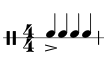
There are different types of bar lines:
 BAR LINE: it divides the stave into bars.
 DOUBLE LINE: it is usually used when there is an important change in the music.
 DOUBLE BAR LINE: it indicates that the end of the piece of music has been reached.
REPEAT SIGNS
Repeat sign is a sign that indicates a section should be repeated.

If
the piece
has one repeat sign alone, then that means to repeat from the
beginning, and then continue on
(or stop, if the sign appears at the
end of the piece).

A corresponding sign facing the other way
indicates where the repeat is to begin.
When you reach the second sign, go back to the
first and repeat the music.
These are often accompanied by first,
second and even third endings.
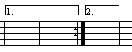
When a repeat calls for a different ending, number brackets above the bars indicate which to played the first time (1), which to play the second time (2), etc. These are called "first-time bars" and "second-time bars," or "first and second endings".
D.C.
Da Capo is a
musical term in Italian, meaning from the beginning
(literally "from the head"). It is often
abbreviated D.C.
D.S.
This is a directional marking. It means
'Del Signo'. When you see this in music, you must go to the sign
(below). This marking may also be accompanied by 'al coda' or 'al
fine'. These mean 'Go to the sign, from there go to the coda' and 'Go
to the sign, from there go to the end' respectively.
 This is the Sign. From here you play to the coda or the end
or wherever the Del Signo directs you.
This is the Sign. From here you play to the coda or the end
or wherever the Del Signo directs you.
 This is the coda sign. It marks when to
go to the special ending, or coda
This is the coda sign. It marks when to
go to the special ending, or codaUsually you won't go to the coda until after a D.S. al coda.
(Italian for "tail", plural code) is a term used in music in a number of different senses, primarily to designate a passage that brings a piece to a conclusion.
