inglés
WORDS AND EXPRESSIONS COME FROM THE ORGANIZATION OF THE GRECO-ROMAN TIME

"TAKE A SIESTA"
ENGLISH WORD: “take a siesta”.
CURRENT MEANING: take a short rest or nap in the early afternoon or after the midday meal, something very frequent in the hot countries.
ORIGIN: the Roman time of day was divided into 12 hours of light and into 12 hours of darkness, but these hours didn´t have the same length. The dawn was the reference used by them, therefore these periods of time were longer in summer than in winter. The hours were expressed through ordinal numbers such as hora prima, secunda, tertia... The hora prima was the dawn, so the hora sexta always represented midday. The sixth hour was used by the ancient roman people for resting and our word siesta derives (via Spanish) from the Latin term sexta.
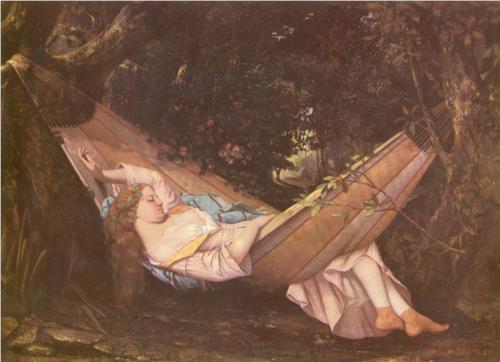
The hammock. Gustave Courbet (1844).
"INTERCALARY OR BISSEXTILE YEAR"
ENGLISH WORD: “intercalary or bissextile year”, "leap year".
CURRENT MEANING: year containing one additional day, so this year has 366 days in order to keep the annual calendar synchronized with the astronomical or seasonal year.
ORIGIN: bissextile is an adjective come from Latin expression bis sextus dies ante Kalendas martii “twice sixth day before the first of March”, making reference to adding one more day between 23-24 February in the Julius Caesar calendar. In the current calendar, known as the Gregorian, made by Gregory XIII, this additional day is February 29.
"FAIR"
ENGLISH WORD: “fair”.
CURRENT MEANING: an exhibition or a market held at a specified time and place for the buying and selling of goods or merchandise, usually accompanied by various entertainments.
ORIGIN: this term has origin in the Latin expression feriae, dies ferialis, the name used in ancient Roma to refer to holidays for visiting temples and making sacrifices to the gods. At the same time, the word was used for public festivals and private celebrations, such as birthdays.
"VIGIL"
ENGLISH WORD: “vigil”.
CURRENT MEANING: this word is used to refer to a period of watchful vigilance or wakefulness kept for any reason during the normal hours for sleeping.
ORIGIN: in the time of Romans, the night was divided into four equal parts, called vigils: vigilia prima, secunda vigilia, etc. They had a different extension depending on the time of year. This distribution into four parts and the name were associated with shifts of surveillance of military camps. The firefighters units in Rome, of a military nature, were also called vigiles, cohortes vigilium.