
 |  |
 MUSIC IN ACIENT GREECE MUSIC IN ACIENT GREECE |
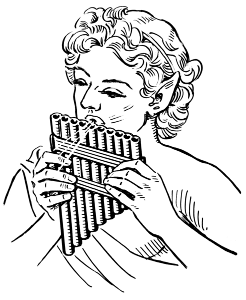
| The word music comes from the Muses, the daughters of Zeus and patron goddesses of creative and intellectual endeavours. The function of music in ancient Greek society was bound up in their Mythology (Hermes, Orpheus, Pan...). It is common to hear the term Music of the Spheres or Harmony of the Spheres (musica universalis): it is an ancient philosophical concept (Pythagoras and his school) that regards proportions in the movements of celestial bodies ( the Sun, Moon, and planets) as a form of music. 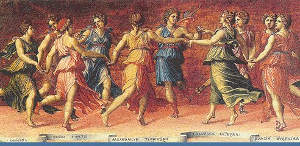 This 'music' is not usually thought to be literally audible, but
a harmonic and/or mathematical and/or religious concept. The idea
continued to appeal to thinkers about music until the end of the
Renaissance, influencing scholars of many kinds, including humanists.
This 'music' is not usually thought to be literally audible, but
a harmonic and/or mathematical and/or religious concept. The idea
continued to appeal to thinkers about music until the end of the
Renaissance, influencing scholars of many kinds, including humanists.The music in the Ancient Greece was almost universally present in society, from marriages and funerals to religious ceremonies, theatre, and the ballad-like reciting of epic poetry. It thus played an integral role in the lives of ancient Greeks.  There are significant fragments of actual Greek musical notation as
well as many literary references (philosophers like Pythagoras, Plato
and Aristotle) about what the music sounded like, the general role of
music in society, the economics of music, the importance of a
professional caste of musicians, etc.
There are significant fragments of actual Greek musical notation as
well as many literary references (philosophers like Pythagoras, Plato
and Aristotle) about what the music sounded like, the general role of
music in society, the economics of music, the importance of a
professional caste of musicians, etc.One of the first fragments the were preserved of this music is the Seikilos Epitaph. |