

|
|
 RELIGIOUS MUSIC: RELIGIOUS MUSIC:MASS & MOTET |
| During the Renaissance the religious music was a growing diffusion because of a new form of write music: the printing,
which allowed for the expansion of an international style common
throughout Europe (and even in the Spanish colonies in America). In religious music, the polyphony, the technique of combining several melodic lines, reached a great perfection. 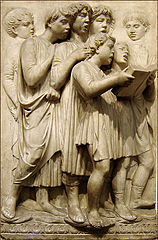 The characteristics of this style are: The characteristics of this style are: ✔ Pieces performed a capella, a musical style that is characterized by using only the voices of the singers to produce the sounds of melody and harmony, instead of using musical instruments. ✔ The text was in Latin, which was the language of the church. ✔ The most important musical forms were the Mass and the motet. ✔ Musical works composed for the four basic voices: soprano, alto, tenor and bass, and every voice had a separate melodic line. Among all they create a mixture that follows the technique of imitation (imitative texture): 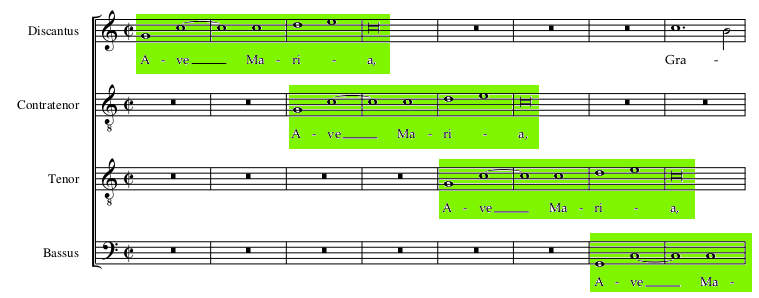 MASS
The 15th and 16th century masses had two kinds of sources that were used, monophonic and polyphonic, with two main forms of elaboration, based on cantus firmus practice or, beginning some time around 1500, the new style of imitation. Three main types of masses resulted: 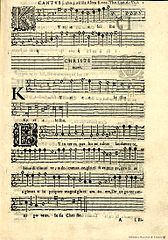 - Cantus firmus mass (tenor mass): the tenor melody is borrowed from the Gregorian chant or from a secular song. - Cantus firmus mass (tenor mass): the tenor melody is borrowed from the Gregorian chant or from a secular song.- Paraphrase mass: the melody is fragmented into the four voices. - Parody mass (Imitation mass): the melody is from a motet or a polyphonic song. The text is changed but the music is similar. Masses were normally titled by the source from which they borrowed. Cantus firmus mass uses the same monophonic melody, usually drawn from chant and usually in the tenor and most often in longer note values than the other voices. MOTET
The Renaissance motet was a polyphonic piece with sacred text and Latin.It assumed a continuous imitative texture of voices of equal importance (in increasing numbers, four, five or even six voices). In the motet the author usually created original music without foreign borrowing as in mass. In the 16th century motets develop large bipartite and in the Venetian school, the polichorals with eight or even twelve voices. Josquin des Prez, Tomás Luis de Victoria or Giovanni Pierluigi da Palestrina were some important religious music composers in the Renaissance.  |