
L I S T E N I N G
-
L I S T E N I N G
-
1st Assessment
-
Listening: Getting ready for school
-
Listening Script: Getting ready for school
(Tapescript) Unit 1 Page 10, Exercises 5 and 6
Emily: Oh, no! My schoolbag is empty. Mum, I’m late for school. Can you help me get ready?
Mother: What do you need?
Emily: Well … I need my calculator – I can’t find it.
Mother: It’s on your desk.
Emily: Oh … and where’s my tennis racket?
Mother: It’s under your bed.
Emily: Are you sure? Oh, you’re right. It’s here behind my boots … and my dictionary?
Mother: Which one?
Emily: My English dictionary. We don’t study French today.
Mother: I think it’s on your shelf. Look on your shelf.
Emily: I don’t see it. Oh, no! I’m so late.
Mother: Look, Emily. It’s right here on your shelf. Do you need your atlas? It’s also on your shelf.
Emily: Err … yes, I do. Thanks. Bye, Mum.
Mother: Wait, Emily. Here’s your sandwich and fruit.
Emily: Thanks, Mum. Bye!
Mother: Oh, Emily!
Emily: Mum! It’s late!
Mother: Do you want your schoolbag?
Emily: Oops!
-
A conversation about school
· Sue and Darren are getting ready to school. Listen to the conversation:
· How are Sue and Darren getting to school today?
· Listen again. Who...
... has got English today?
... is taking the laptop?
... has got swimming practice in the morning?
... is taking food to school?
... is having breakfast now?
-
Listening Script: A conversation about school
Sue: Darren, where’s the dictionary?
Darren: It’s in my schoolbag.
Sue: Why?
Darren: I need it. I’ve got English today.
Sue: Well, I’ve got English today, too, and I need it first. My English lesson is at 9.00.
Darren: Oh – all right. Take it now, but give it to me after the lunch break. My lesson is in the afternoon.
Sue: OK. Do you need a calculator?
Darren: No. I’m taking my laptop.
Mum: Are you having breakfast, Darren?
Darren: No, Mum. I never have breakfast before swimming practice. I’ve got a sandwich and an apple in my bag for breakfast after swimming practice.
Mum: That’s fine, Darren. But, you’re late!
Darren: No, I’m not, Mum, I’m leaving now – bye!
Mum: See you! What are you doing, Sue? Your dad and Darren are waiting for you.
Sue: I’m finishing my breakfast. Mum, I’ve got art today and I can’t find my paintbrushes. Do you know where they are?
Mum: They’re on the shelf in your room. Hurry up, Sue! Dad and Darren are already in the car.
-
Museum tours
· Students from the Institute of Science and Technology are visiting the New York Hall of Science.
· Listen to the fisrt tour:
· Which activities do the people mention?
1. Using microscope
2. Doing experiments
3. Checking e-mails
4. Building models
5. Repairing computers
6. Taking photographs
· Listen to the first tour again and answer the questions:
1. What are the students building in the New York Halll of Science?
2. Who is taking photographs there?
· Now listen to the second museum tour and complete the sentences in your notebook:
1. Every year about ................... people visit the Louvre Museum.
2. Leonardo da Vinci was an ................. artist.
3. The Monna Lisa isn't a .................... painting.
4. Mona Lisa is wearing a ..................... .
5. The museum tour guide thinks Mona Lisa is .......................... .
-
Listening: Conversation between Mark and John in town
-
Listening: Making plans
Listen to Stacy and Dave making plans:
1. What do they decide to do together?
2. Listen again and choose the correct answer:
1. When Dave calls Stacy, she is...
a) outside a Chinese restaurant
b) at the bowling alley
c) outside an Italian restaurant
2. Dave is at the ...
a) hairdresser's
b) cinema
c) bowlling alley
3. For lunch Dave wants ... food.
a) Italian
b) Japanesse
c) Chinese
4. Stacy's friends plan to...
a) go to a party
b) go bowling
c) go to the cinema
-
Listening: A radio interview
Listen to a radio interview:
1. What is Yupik?
2. Listen again and choose the TWO correct aswers:
1. Sam lives in...
a) a big city.
b) Alaska.
c) Fairbanks.
2. Acording to Sam, it's ... in the winter.
a) dark
b) snowy
c) warm
3. Sam's hobbies are ...
a) playing computer games.
b) doing outdoor sports.
c) cooking.
4. .... speak Yupik.
a) Eskimos
b) Sam and his friends
c) Sam's aunt and uncle
3. Do you remember? Answer the questions:
1. Who cooks with Sam?
2. What are Sam's favourite subjects at school?
-
Listening: A phone conversation between Marko and his sister Raina
-
Listening (A radio programme): "Something to think about"
-
2nd Assessment
-
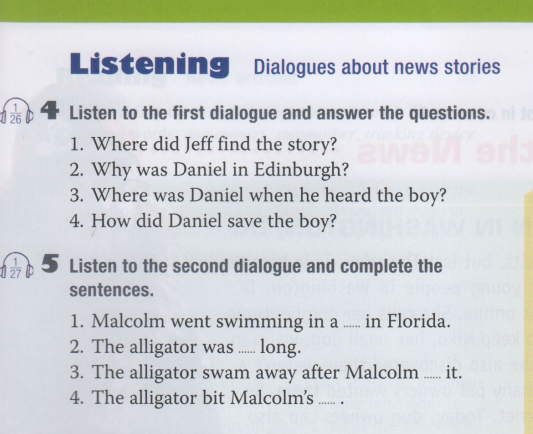
Listening: Dialogues about news stories
-
Listening: A conversation between Emily and her grandmother Abigail.
-
Listening: Talking about school projects.
-
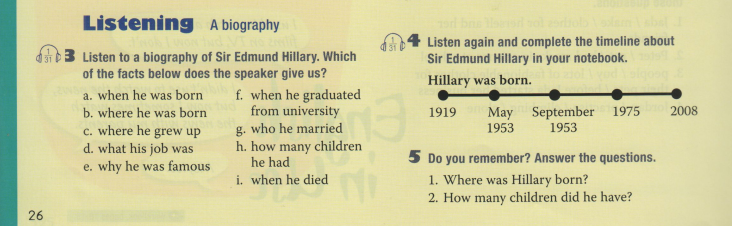
Listening: A biography
-
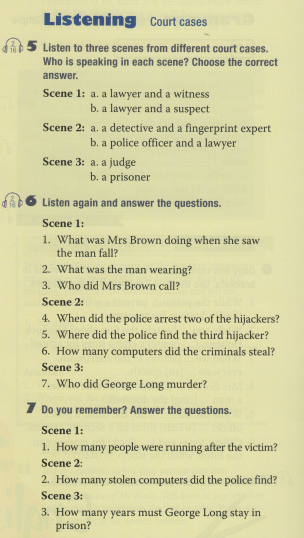
Listening: Court cases
-
Listening: A crime story

-
Listening: A crime story

-
3rd Assessment
-
Listening: A conversation in a jewellery shop

-
Listening: A conversation in a jewellery shop
(Comparaison of adjectives)(Tapescript) Unit 6 Page 72, Exercises 5 and 6
Oliver: Here’s the jewellery shop.
Alice: Oh, good. I’m excited already. It was a great idea to buy Mum a ring for her birthday.
Salesman: Can I help you?
Oliver: Yes, please. We’re looking for a ring for our mother. It’s her birthday.
Salesman: You’re in the right place. We have got the largest selection of rings in the city.
Alice: The largest selection in the city, wow. I’m sure we’ll find something nice for Mum.
Salesman: What type of ring are you interested in?
Oliver: Something attractive but not very elaborate.
Alice: How about that ring? It’s attractive and it isn’t very elaborate. Is it gold?
Salesman: Of course. Everything in our shop is white or yellow gold. Here, look at it. It’s quite unusual, isn’t it?
Alice: Yes, it’s very unusual. I love the blue stone!
Oliver: … It’s also very expensive! Look at that, Alice! 1,000 pounds!
Alice: A thousand pounds! That’s more than our pocket money for a year!
Oliver: Have you got anything cheaper than that ring?
Salesman: Well, there are some cheaper rings, but they’re plainer than the first ring.
Alice: That’s OK. Plain rings can be very attractive, too.
Salesman: Very well. How about this ring?
Alice: Oh, it’s very light.
Salesman: That’s one reason it is cheaper than the first ring. Heavier rings are more expensive because they have got more gold in them.
Oliver: What do you think, Alice?
Alice: I like it. It’s plain, but the bright gold is pretty. There’s just one problem.
Oliver: What is that?
Alice: I put it on my finger and now I can’t take it off!
-
Listening: Talking about photos of different places
-
Listening: Discussing a weather forecast
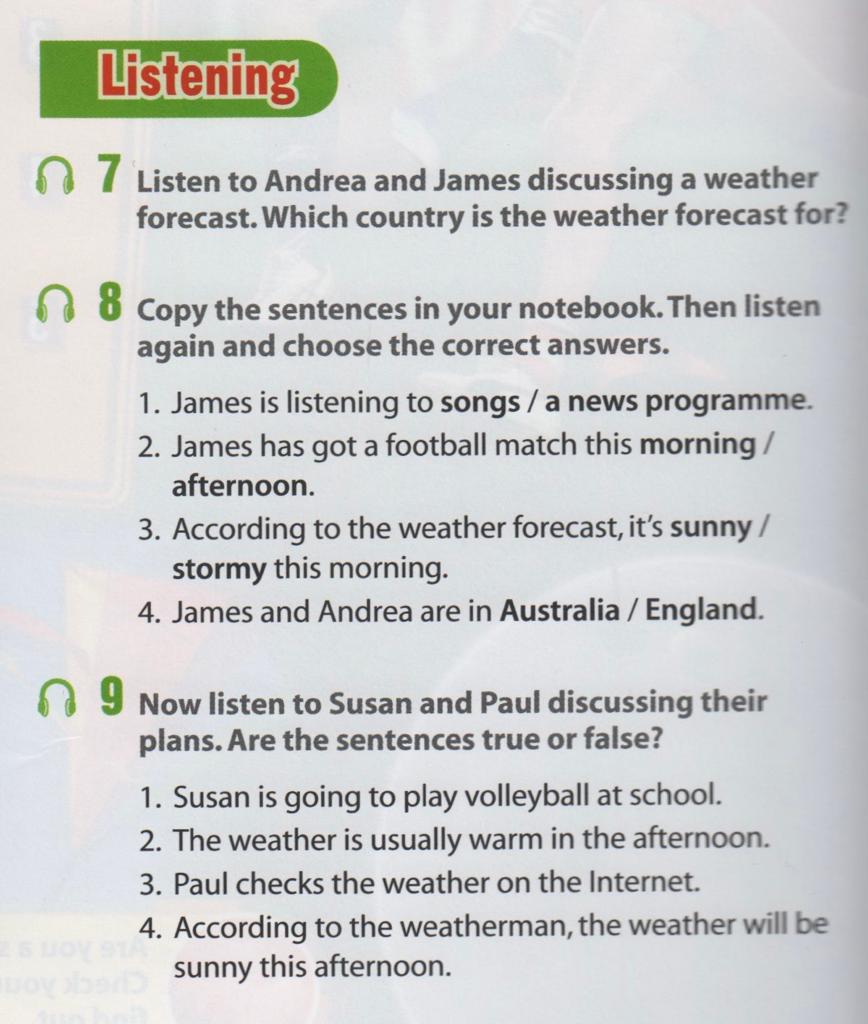
Listening: Discussing plans
-
Listening: Discussing a weather forecast
(Tapescript) Unit 5 Page 60, Exercises 7 & 8
Andrea: Hi, James, what are you listening to? Have you got some new songs?
James: No, it’s a news programme on the Internet. I’m waiting for the weather forecast.
Andrea: Why do you want to listen to the weather forecast?
James: Because I’ve got a football match this afternoon.
Andrea: A football match? Well, take the earphones off so I can hear it, too.
James: Fine.
Weatherman: And here’s the weather. Right now, it’s sunny and very warm this morning. Quite sunny and warm. But according to our weather pictures, a storm is moving towards us from the north. If it reaches us, it will rain heavily, with thunder and lightning later this afternoon.
James: Did you hear that? Rain, thunder and lightning. I’m going to play football in the rain!
Andrea: Hey, wait a minute, James. That was an Australian news station. Don’t you know how to use the Internet? We were listening to the forecast for Australia, not England!
Listening: Discussing plans (predictions)
(Tapescript) Unit 5 Page 60, Exercise 9
Susan: Hey, Paul. I’m going to play volleyball at the beach after school. Do you want to come with me?
Paul: It’s cool outside. It isn’t a good day for the beach.
Susan: It’s cool because it’s early. It’s usually warm in the afternoon.
Paul: Let’s check. Turn on the TV.
Weatherman: It’s cool this morning, but in the afternoon the weather will change.
Susan: See? I was right.
Paul: OK. I’ll meet you at the beach after school.
Paul’s Mum: Paul, where are you going after school?
Paul: Oh, hi, Mum. We’re going to the beach.
Paul’s Mum: No, you’re not. Didn’t you watch the weather forecast?
Susan: Yes, we did. According to the forecast, the weather will change this afternoon.
Paul’s Mum: That’s right. It’ll change, but next time, listen to the forecast till the end.
The weather will change – it’ll be rainy and windy.Paul and Susan: Rainy and windy? Oh!
-
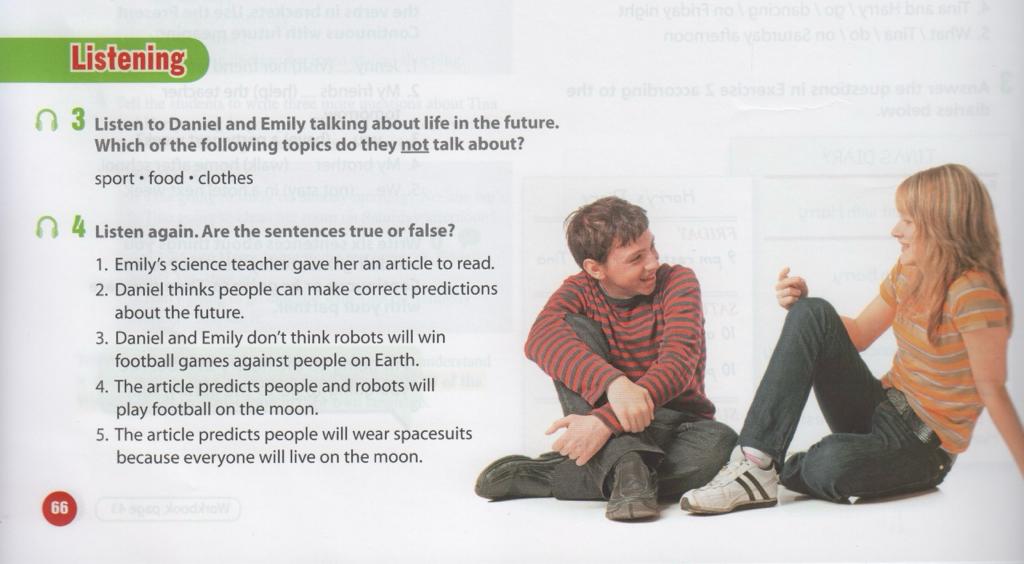
Talking about life in the future
-
Talking about life in the future
(Tapescript) Unit 5 Page 66, Exercises 3 & 4
Unit 5 Page 66, Exercises 3 and 4
Daniel: What are you reading, Emily?
Emily: Oh, hi Daniel. It’s an article about life in the future – in 50 years from now. It’s really interesting. My computer technology teacher gave it to me to read.
Daniel: Oh I don’t believe any of those things. How can we know anything about life 50 years from now? Anything can happen in 50 years!
Emily: I think scientists can make some correct predictions. They see the developments
in science and technology. Think about robots, for example. We’ve already got simple robots. So robots will probably do more difficult tasks in the future. According to this article, robots will even play football against people one day! And there will be robot coaches and robot referees, too.Daniel: Maybe robot football players will play against people, but I’m sure they won’t win.
Emily: I agree robots can’t win games with people on Earth, but according to the article, we will have football matches on the moon one day. I think people will definitely lose matches
on the moon. It will probably be difficult for them to play football in spacesuits!Daniel: I’m sure spacesuits won’t be big and heavy like they are now. I often wonder how clothes will change in the future. Does the article say anything about clothes?
Emily: Yes, it does. According to this article, everyone will wear spacesuits here on Earth too,
if we don’t stop pollution very quickly. The air on Earth will be very bad for us, so people will wear special spacesuits to protect them. Can you imagine going to school in
a spacesuit? I hope they’ll be pretty at least.Daniel: Well, maybe there won’t be schools in the future. If pollution is such a big problem, maybe children will stay home.
Emily: No school? I don’t think so. But it’s fun making all these predictions.
-
Listening: A conversation about wish lists
Listen to a conversation between Melanie and Ben about wish lists:
1. Where are they going tonight?
2. Listen again. Are the sentences below true or false?
1. Ben went abroad with his class.
2. Melanie has taken lessons in self-defence.
3. Ben wants to put skiing on his wish list.
4. Melanie wants to ride an elephant.
5. Melanie volunteers at the animal hospital.
6. Melanie has been to South Africa
-
Listening: A conversation about wish lists
(Tapescript) Unit 7 Page 91, Exercises 6 and 7
Ben: Hi, Melanie. What are you doing?
Melanie: Hi, Ben. I’m making a wish list of things I want to do before I’m 30 years old. I really want to go abroad – I want to see the world.
Ben: I haven’t been abroad, but last year I went on a great trip to Cornwall with my class.
We went horse-riding and we rowed boats. It really was a lot of fun.Melanie: I haven’t done anything like that … not anything exciting in nature, but last summer, I took lessons in self-defence. I did judo. I really enjoyed it. I’m too busy for judo lessons right now, but I want to continue learning judo this summer. I’m adding that to my wish list.
Ben: Well, at the top of my wish list I’d put – learn to ski. I haven’t tried skiing yet, but I want to. I’d like to go to the Alps in Switzerland. What else is on your wish list, Melanie?
Melanie: Animals, lots of wild animals …
Ben: What do you mean?
Melanie: I’ve been to some zoos and have seen some unusual animals, but I’d like to go abroad and see animals in nature – ride an elephant in Thailand or maybe … go on a safari.
I love animals! I want to work with animals one day – you know, look after them and feed them.Ben: Hey, why don’t you volunteer at the animal hospital one day?
Melanie: Maybe one day, but visiting Kenya or South Africa will be at the top of my wish list.
Ben: Let me see your wish list when you finish it.
Melanie: OK.
Ben: See you tomorrow, Melanie. Bye.
Melanie: Wait, Ben. Have you forgotten … we’ve got Sam’s birthday party tonight.
Ben: Oh! I almost forgot. See you at 8.00, then. Bye.
-
Listening: Talking about the news
Listen to James and Andrea talking about the news:
1. How many newspaper articles do they discuss?
2. Listen again. Are the sentences true or false?
1. Andrea thinks newspapers aren't interesting.2. The children in the article found a dolphin.3. The coins are in a museum now.4. The advert is for trainers.5. Andrea decides to go home. -
Listening: Talking about the news
(Tapescript) Unit 7 Page 86, Exercises 6 and 7
Andrea: I don’t like this homework assignment, James. Newspapers are boring. We’ll never find interesting articles to take to class.
James: Why not? Look at this, Andrea. Dolphins Save a Man’s Life.
Andrea: I’ve never heard of anything like that. Let me see the newspaper.
James: Here.
Andrea: Wow. You’re right. Dolphins pushed a man’s boat to the beach. That’s amazing! I didn’t know dolphins liked people.
James: I didn’t know it either. Let’s cut out the article.
Andrea: Wait a minute. Look at this article. Some children were digging for treasure in their garden and they discovered a box with ancient gold coins in it! According to experts,
the coins are very valuable. They’re worth a million pounds!James: A million pounds in their garden? Wow! Have they sold the coins? Did the children
get to keep the money?Andrea: Of course not, silly. The coins are in a museum now. Please give me the scissors so I
can cut the article out.James: Here, but have you checked the other side of the page first? Maybe there’s another interesting news story there.
Andrea: No, I haven’t. Oh, there’s just an advert for trainers, so I’m cutting out the article about the gold coins.
James: Did you say an advert for trainers?
Andrea: Yeah. If you take the advert to the shop, their Kobe Bryant trainers will cost you only £20.
James: Twenty pounds? Wait a minute! Stop cutting the newspaper! I want the advert!
Andrea: It’s too late. I’ve already cut it. Sorry.
James: Oh. Then I’m going home – quickly.
Andrea: What are you talking about? We haven’t finished our homework yet.
James: I know, Andrea, but I want that advert for Kobe Bryant trainers – before my parents throw out their newspaper.
-
Listening: Talking about experiences
Listen to Mike and Janet's conversation:
1. Which types of animal do they mention?
2. Listen again. Who... ?
1. likes the idea of bathing an elephant
2. has bathed an elephant
3. likes the idea of swimming with sharks
4. has never touched a spider
5. has got unusual pets
6. has held a snake
-
Listening: Talking about experiences
(Tapescript) Unit 7 Page 92, Exercises 3 and 4
Mike: What’s that, Janet?Janet: It’s a survey about different experiences. It was in the school newspaper. There are some really unusual things here.
Mike: Experiences? Like what?
Janet: Well, for example, have you ever bathed an elephant, Mike?
Mike: No, I’ve never bathed an elephant. Why would people do that?
Janet: Because it’s fun. I saw someone bath an elephant on TV. It was in India. This boy Raj took an elephant to the river. The elephant lay down in the water and the boy washed
it. Then the elephant started playing with Raj in the water.Mike: That’s not my idea of fun. What else is on the survey?
Janet: Swimming with sharks is the next experience. But that’s crazy! How crazy can people be? Sharks are dangerous.
Mike: Sharks are only dangerous if they’re hungry. They’re actually afraid of people. Swimming with sharks sounds really exciting to me. I’ve never done it, but I’d love
to!Janet: I think it’s too frightening. So is the next activity: Touch a spider. Disgusting! I saw
a Black Widow spider at the Museum of Natural History. It was disgusting! Who wants to touch one?Mike: Actually, I have touched one. My cousin has got some very unusual pets, and one
of them is a Black Widow spider. He’s had him for about three months. I’ve touched it – and held it, too.Janet: I can’t believe you’ve held a spider! Remind me not to shake hands with you.
Mike: Very funny. I’ve also held my cousin’s snake. It’s a boa …
Janet: Stop! I’ve heard enough. Why don’t you and your cousin volunteer at a reptile sanctuary? You can touch snakes all day there.
Mike: That’s not a bad idea. Actually, it sounds really interesting. Is volunteering at a reptile sanctuary one of the experiences on the survey?
Janet: Yes, it is – but no one liked it.
-
Listening: Talking about noise!
-
Listening: Talking about an experience
-
Listening: Talking about an experience
(Tapescript) Unit 3 Page 116, Exercises 4 and 5
Ed: Hi, Lily. You look terrible. What’s wrong?
Lily: I had a really bad experience last night, Ed.
Ed: Where were you?
Lily: I was at home.
Ed: Were you alone?
Lily: Yes, my parents went to London to visit my grandparents.
Ed: I’m surprised.
Lily: Why are you surprised? They often visit my grandparents. I usually go with them,
but I couldn’t go yesterday because of the maths exam. I wanted to study.Ed: I’m surprised because you were alone and you didn’t have a party. You should always have a party when your parents go out of town.
Lily: Come on, Ed. You know my parents don’t like parties in the house and I wanted to study. So can I continue my story, please?
Ed: Yes. Sorry.
Lily: As I was saying, I was home alone. I finished studying for the maths exam. Then I had dinner.
Ed: What did you have?
Lily: Pizza.
Ed: And you didn’t invite me to join you? Did you have pizza with olives or with –
Lily: Can you stop it, Ed?
Ed: OK, sorry. So, what happened next?
Lily: I watched a film on TV. It was a very long film about the history of witches. It wasn’t very interesting and I was exhausted. I fell asleep on the sofa in the middle of the film.
Ed: Oh, I often fall asleep on the sofa. My parents hate it.
Lily: Anyway, when I woke up, I turned off the TV and went to the kitchen to wash my dishes. While I was washing the dishes, I suddenly heard a strange noise.
Ed: What type of noise?
Lily: It sounded like someone was trying to open a window from outside.
Ed: Wow! A thief!
Lily: That’s what I thought. I was really frightened. I called the police immediately
on my mobile phone.Ed: Good for you, Lily. I’m proud of you. So did the police catch the thief?
Lily: No, they didn’t, because there wasn’t a thief. It was my parents.
Ed: Your parents?
Lily: Yes. They left their keys at home so they couldn’t open the door. It was very late and they didn’t want to wake me, so they tried climbing through a window. Then the police came –
Ed: Wow! How did your parents feel? Were they very angry with you?
Lily: No, they weren’t angry. But we were all very embarrassed!
-
Listening: A dialogue between Lisa and Kate about a bad experience
-
Listening: A dialogue between Lisa and Kate about a bad experience
(Tapescript) Unit 9 Page 77; Exercises 4and 5 (EW - WORKBOOK) (Non atopado)
-
Listening: Dialogues about superstitions
-
Listening: Dialogues about superstitions
(Tapescript) Unit 9 Page 110, Exercises 5 and 6
1. Peter: Louise, you’re not superstitious, are you?
Louise: Not really. Why do you want to know, Peter?
Peter: I closed the front door really hard when I came into your house and the mirror next
to the front door fell down and broke. Please don’t be angry. It was an accident.Louise: The mirror next to the front door? Oh, no! That’s terrible, Peter. You should be more careful when you close a door.
Peter: So you are superstitious! I can’t believe it!
Louise: No, I’m not. It’s terrible because it’s my mother’s favourite mirror. My father gave
it to her on her 40th birthday. She’ll be really angry!2. Susan: Oh, no, James! I’ve just seen a black cat.
James: So, I’ve just seen a black cat too, Susan. Seeing a black cat isn’t bad luck. That’s just
a silly superstition.Susan: Really? Then can you explain Linda’s mark in the maths test last week? She’s
a brilliant maths student. She can answer any maths exercise. But she received a mark of 40 in the last test! Now listen to this. Linda was walking to school on the day of the test and she saw a big black cat. It was just an hour before the test.James: Susan! Linda received a mark of 40 because she was ill. She didn’t feel well, so she couldn’t finish the test. She went home and she’s taking the test again today!
3. Emily: Charles! What’s wrong? You look terrible! Maybe you should go home.
Charles: I feel terrible and it’s all because of my new trainers.
Emily: What’s wrong with them? Are they too small?
Charles: No, Emily, they’re perfect. It’s all because I put them on the table.
Emily: Oh, don’t be silly. It isn’t bad luck to put your shoes on the table, Charles.
Charles: I’m not talking about superstitions, Emily. Listen to what happened. When I came home from the shop, I put the box with the trainers on the kitchen table. Well, there was a cup of hot soup on the table, too, but I didn’t see the cup of soup. I pushed the cup over with the box and the hot soup went on my legs. My legs still hurt!
-
Listening: A discussion about a record breaker

-
Listening: Monologues about healthy habits
5. Listen to three monologues about healthy habits.
Which of the following do the teenagers mention?
1. Chewing gum 4. Cola
2. Sugar 5. Pizza
3. Salt 6. Chocolate
6. Listen again and decide if the sentences below are true or false.
Correct the false sentences.
Speaker 1:
1. The chewing gum can be good for your teeth.
2. The speaker always chews gum in maths lessons.
Speaker 2:
3. The speaker studied for a histrory exam last week.
4. The speaker felt relaxed during the exam.
Speaker 3:
5. Chocolate isn't bad for your skin.
6. There are about 50 calories in a big bar of chocolate.
-
Listening: A dialogue about school projects
-