

|
|
 EXPERIMENTAL MUSIC EXPERIMENTAL MUSIC |
Experimental music refers to a compositional tradition which arose in the mid-20th century, applied particularly in North America to music composed in such a way that its outcome is unpredictable.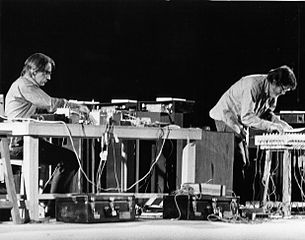 Its most famous and influential exponent was John Cage. More loosely, the term "experimental" is used in conjunction with genre names to describe music within specific genres; sometimes it has been used to describe the mixture of recognizable music genres. A quite distinct sense was current in the late 1950s to describe computer-controlled composition, and the term at that time also was sometimes used for electronic music and musique concrète. "Experimental music" has also been used in music journalism as a general term of disapprobation for music departing from traditional norms. |
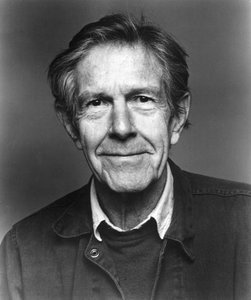 John Cage
was an American composer, music theorist, writer, and artist. A pioneer
of indeterminacy in music, electroacoustic music, and non-standard use
of musical instruments. John Cage
was an American composer, music theorist, writer, and artist. A pioneer
of indeterminacy in music, electroacoustic music, and non-standard use
of musical instruments. Cage was one of the most influential American composers of the 20th century. He was also an important figure in the development of modern dance. Cage is perhaps best known for his 1952 composition 4′33″, which is performed in the absence of deliberate sound; musicians who present the work do nothing aside from being present for the duration specified by the title. The content of the composition is not "four minutes and 33 seconds of silence," as is sometimes assumed, but rather the sounds of the environment heard by the audience during performance.  He was also a pioneer of the prepared piano (a piano with its sound altered by objects placed between or on its strings or hammers), for which he wrote numerous dance-related works and a few concert pieces.  |
