

|
|
 VOCAL MUSIC VOCAL MUSIC |
| OPERA Opera
is an art form in which singers and musicians perform a dramatic work
combining text (called a libretto) and musical score, usually in a
theatrical setting.
It incorporates many of the elements of spoken theatre, such as acting, scenery, and costumes and sometimes includes dance. The performance is typically given in an opera house, accompanied by an orchestra or smaller musical ensemble. The opera was born in Italy in the late sixteenth century with the Florentine Camerata experiments, combining music, theatre and dance. Monteverdi, with his Orfeo consolidated the opera form. The parts of an opera are: - Oberture: first instrumental piece performed by the orchestra. - Recitatives, in which the singers are advanced dialogues of the play on a syllabic singing accompanied only by basso continuo. - Arias, a solo musical piece lyrical and elaborate, often virtuous, serving the brilliance of pure delight singer and music. Towards the end of the period was imposed ABA 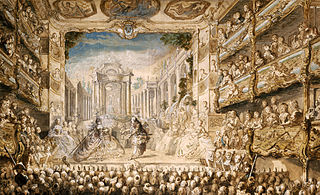 form, call da capo aria. form, call da capo aria.- Dances - Choirs, usually for four voices, in imitation of the chorus of Greek theater. 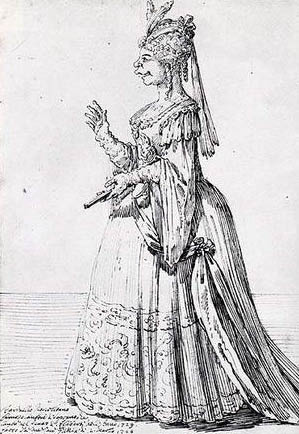 Some performance were with castrati:
a type of classical male singing voice equivalent to that of a soprano,
mezzo-soprano, or contralto. The voice is produced by castration of the
singer before puberty, or it occurs in one who, due to an
endocrinological condition, never reaches sexual maturity. They became
the first operatic superstars, earning enormous fees and hysterical
public adulation (as Farinelli). Some performance were with castrati:
a type of classical male singing voice equivalent to that of a soprano,
mezzo-soprano, or contralto. The voice is produced by castration of the
singer before puberty, or it occurs in one who, due to an
endocrinological condition, never reaches sexual maturity. They became
the first operatic superstars, earning enormous fees and hysterical
public adulation (as Farinelli).The opera was imposed as the big show of the Baroque across Europe in Italian (except in France that the opera was writen in French). Similar musical-theatrical genres were most popular in vernacular with contemporary and humorous characters (often lower class) and spoken passages instead of recitatives. These shows were introduced either as an intermediate between acts of opera seria or as independent works; given different names in each country: Singspiel (Germany), zarzuela (Spain), opera buffa and intermezzi (Italy), opéra-comique (France), etc.  ORATORY
Musically almost identical to the opera (though with more emphasis on choirs), used to have a religious theme and it was not staged (as "concert versions"). Unlike the opera, usually in Italian, used oratorios written in the vernacular.
The most famous example is The Messiah, by Handel. A particular case of oratory, represented in the Protestant churches of the time, was the Passion. The St. Matthew Passion of Bach is his most popular example. CANTATA
The cantata was a new religious form in vernacular, not staged, with instrumental symphonies, recitatives, arias and choirs.
The composition and performance of new vernacular religious cantatas was part of everyday obligations musicians Lutheran countries (Bach composed more than two hundred). |