

|
 SECULAR MUSIC: SECULAR MUSIC:TROUBADOURS & JONGLEURS |
| The domain of religion in medieval musical culture resulted in a lack of interest in popular song, considered a pagan event. MINSTRELS AND JONGLEOURS 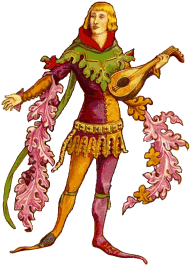 Minstrels and Jongleours were wandering characters who Minstrels and Jongleours were wandering characters who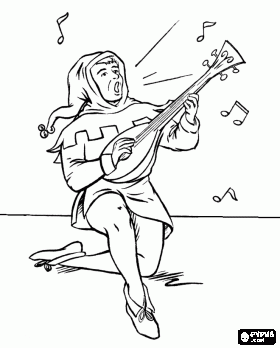 went from city to city in order to entertain the public, whether in town squares, festivals or markets. went from city to city in order to entertain the public, whether in town squares, festivals or markets. They were the representatives of popular secular song and they belonged to the lower class. Despite their low social status, they knew how to do a little of everything: from singing or reciting to playing instruments, dancing or performing complicated acrobatics. TROUBADOURS
 The troubadours
emerged in southern France as a result of the Crusades of the late XI
Century, in order to narrate the highlights of these. They used to be
poets, composers (of lyrics and music) owned by nobility or the
bourgeoisie. The troubadours
emerged in southern France as a result of the Crusades of the late XI
Century, in order to narrate the highlights of these. They used to be
poets, composers (of lyrics and music) owned by nobility or the
bourgeoisie. 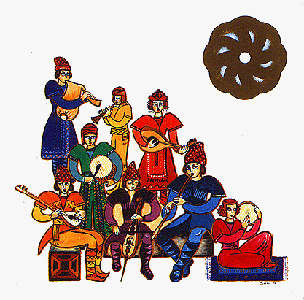 They sung in Provençal language, away from the Latin texts of religious music. They sung in Provençal language, away from the Latin texts of religious music.The main themes of their works were love, war (historical and heroics events), the nature,honor and singing to their ladies. They were accompanied by various instruments like the viola, harp, lute and percussion. The trobairitz were the female troubadours, the first female composers of secular music in the Western tradition. In Spain secular song was called cantigas. There were different types: ✔ Cantigas de amor: songs of love, the lover sang to attract the attention of his sweetheart. ✔ Cantigas de amigo: songs of friendship, the girl in love sang, sadly, the absence of her lover who she called “amigo”. ✔ Cantigas de escarnio ou maldicir: songs of scorn and cursing, with moral and satirical topics. 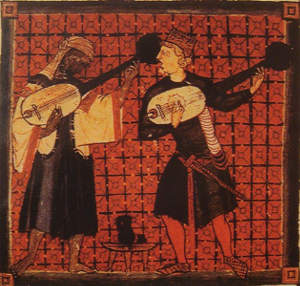 All songs are contained in a series of songbooks or codices. The Cantigas de Santa Maria are 420 poems with musical notation, written in Galician-Portuguese during the reign of Alfonso X El Sabio (1221–1284) and often attributed to him. It is one of the largest collections of monophonic (solo) songs from the Middle Ages and is characterized by the mention of the Virgin Mary in every song, while every tenth song is a hymn. The manuscripts have survived in four codices: two at El Escorial, one at Madrid's National Library, and one in Florence, Italy. Some have colored miniatures showing pairs of musicians playing a wide variety of instruments. Alfonso X the Wise (Cantigas de Santa Maria), Martin Codax (which had seven cantigas de amigo), Xoán de Cangas (three preserved ballads) and Mendiño (which had a cantiga de amigo) are some highlights of the troubadours.  |