
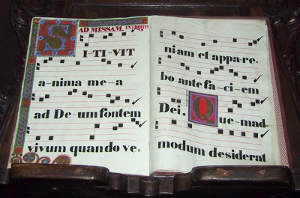
 FIRST MUSIC NOTATION FIRST MUSIC NOTATION |
| Scholar and music theorist Isidore of Seville, writing in the early 7th century, considered that "unless sounds are held by the memory of man, they perish, because they cannot be written down." By the middle of the 9th century, however, a form of neumatic notation began to develop in monasteries in Europe as a mnemonic device for Gregorian chant, using symbols known as neumes. These signs, neumes, were placed on the text, indicating the singers rise or fall in pitch of the sound. 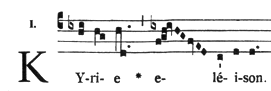 The problem with this notation was that it only showed melodic contours and consequently the music could not be read by someone who did not know the music already. In X Century a horizontal line in red was added, to separate the different pitchs of sound more precisely. After, another yellow appear. And so on up to three lines. In the XI Century, Guido D'Arezzo, a Benedictine monk, introduced a fourth line, making the four-line stave ( tetragrama, set of four lines and three spaces, a predecessor of the stave). He also gave names to musical sounds, creating what we call notes. For that, he used the first syllables of the first verses of St. John the Baptist Hymn: UT, RE, MI, FA, SOL, LA.  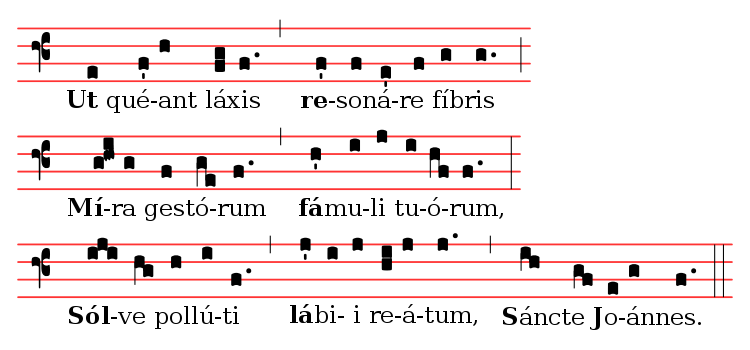 In some languages (like English) the initial S changed to T (TI) so that each note would begin in a different consonant (SOL and SI start both in S). The modern five-line stave was first adopted in France and became almost universal by the 16th century. 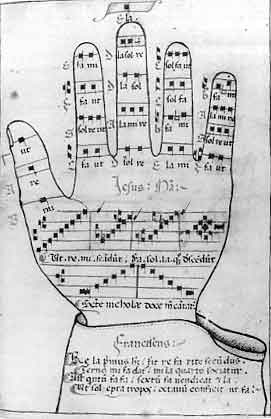 In Medieval music, the Guidonian hand was a mnemonic device used to assist singers in learning to sight-sing. Sight-reading is the reading and performing of a piece of written music, specifically when the performer has not seen it before, also called a prima vista. Sight-singing is often used to describe a singer who is sight-reading.  |