|
MIDDLE AGES
DARK AGES
EARLY XX CENTURY
REGIME OF FRANCO
LATE XX CENTURY
MIDDLE AGES
The
origin of traditional Galician music is dark.
The
earliest reference dates back to medieval music, yet it retains
several songbooks generally do not include musical notation.
An
execption was Martin Codax (troubadour of the 13th Century), because
two scores are kept with the lyrics and music for his composition.
Significant
also are the Cantigas de Santa Maria of Alfonso X, not only to
include the music and show illustrations of
people playing bagpipes and other traditional instruments
, but also for their importance of the Galician culture of the Middle
Ages. 
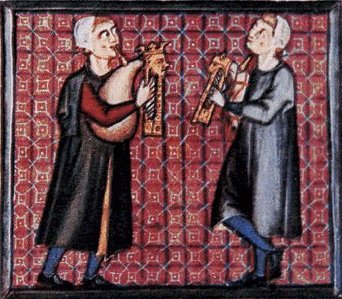 It
is known that the bagpipe was common at that time, and in
general the main instruments were already present in traditional
music: bagpipes, hurdy-gurdy and string instruments appear in
codices, or in the well-known Pórtico da Gloria of the
Cathedral of Santiago. It
is known that the bagpipe was common at that time, and in
general the main instruments were already present in traditional
music: bagpipes, hurdy-gurdy and string instruments appear in
codices, or in the well-known Pórtico da Gloria of the
Cathedral of Santiago. 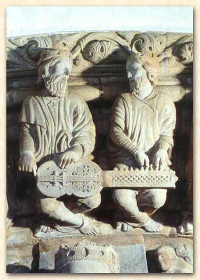
These representations allow the
reconstruction of the instruments and make possible the current
interpretations of medieval music nowdays.
DARK AGES
Coinciding
with the Dark Ages and the decline of the use of the Galician
language,
the traditional music turns out to be only oral
transmission:
christmas songs, lullabies, songs of blind.
EARLY XX CENTURY
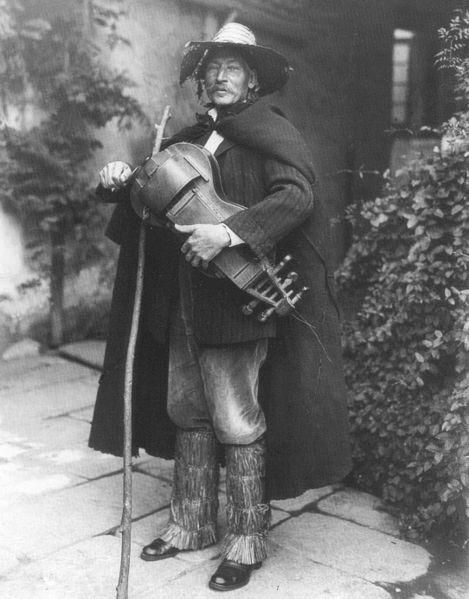 The Galician folk revival began on early 20th century, with performers like Perfecto Feijoó, a bagpipe and hurdy-gurdy player. The Galician folk revival began on early 20th century, with performers like Perfecto Feijoó, a bagpipe and hurdy-gurdy player.
The first commercial recording of Galician music had come in 1904,
by a choir called Aires d'a Terra from Pontevedra.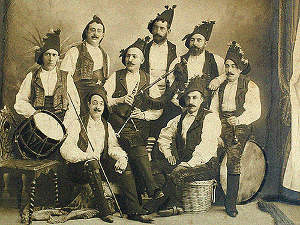
REGIME OF FRANCO
During
the regime of Franco, the music has been forced to adapt to the
political vision of the moment with patriotic performances in
Spanish language, which led to the decline of traditional styles.
LATE XX CENTURY
When Franco's regime ended in 1975,
Galician music experienced a strong revival and recordings flourished.
The establishment of the Festival Internacional do Mundo Celta (Ortigueira 1977)
helped establish some Galician bands.
Aspiring performers began working with bands like Os Areeiras de Catoira, Os Rosales, Os Campaneiros, learning their folk styles; others went to the renowned workshop of Antón Corral (a bagpipe luthier) at the Universidade Popular de Vigo.
Some of these musicians then formed their own bands, like Milladoiro. 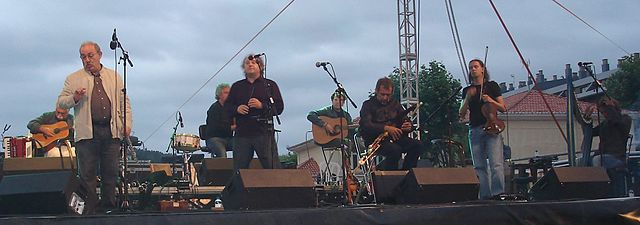
 In the 1980s and 1990s, some Galician performers began to win fame within Spain In the 1980s and 1990s, some Galician performers began to win fame within Spain 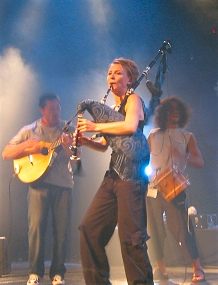 and
the international celtic folk
scene. and
the international celtic folk
scene.
Galician musicians of this period included Uxía or Mercedes Peón (singers), Fía na Roca (folk band), Carlos Núñez, Xosé Manuel Budiño, Cristina Pato
or Susana Seivane
(modern Galician bagpipes players).
|

