Western Europe
Some European democracies agreed on the foundation of some common institutions to create a European identity: The British Prime Minister, Winston Churchill, suggested in 1946 that Europe could compete with the USA and the USSR as a leading nation. The French Minister of Foreign Affairs, Robert Schuman, proposed on 9th May 1950 the creation of a common market of coal and steel to avoid rivalries and to be more competent. Hence, that day is commemorated as the Day of Europe since it is considered the foundations of the European Union.
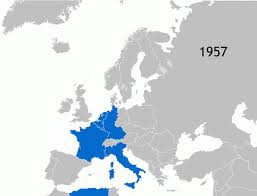
Shortly after, some treaties were signed by some European countries in order to fulfil that goal:
- Benelux Customs Union (1948). It was an agreement that was signed by Belgium, the Netherlands, and Luxembourg in order to remove customs and to promote free movement of capital, goods, and workers.
- Treaty of Paris (18th April 1951). It involved the creation of the European Coal and Steel Community (ECSC) It was signed by France, Western Germany, Italy, Belgium, the Netherlands, and Luxembourg. It created a free-trade area for coal and steel in the signing countries.
- Treaty of Rome (25th March 1957). It constituted the creation of the European Economic Community (EEC) or Common Market. Its main objectives were the free movement of people, goods, services, and capitals by suppressing the customs duties among the member countries. It was signed by West Germany, France, Italy, Belgium, the Netherlands, and Luxembourg. It also involved the creation of Euratom (European Atomic Energy Community) for the development and research of the nuclear energy with pacific goals as well as creating a common market of nuclear fuels.