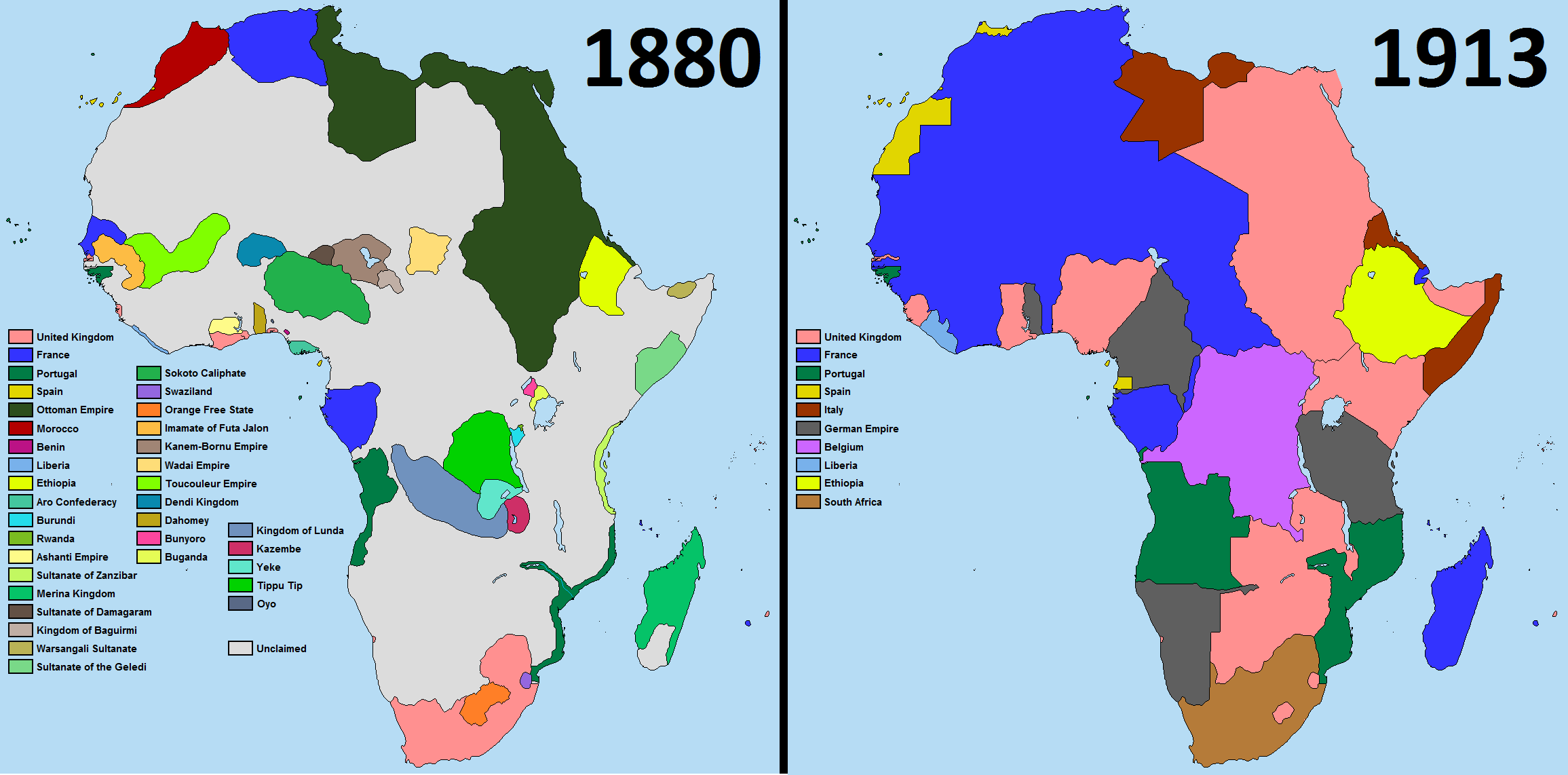
The scramble for Africa
Africa was almost unknown to the Europeans at the beginning of the 19th century.
By 1830 only the coasts were known by the Europeans, who founded ports to trade with the local tribes.
France and Great Britain wanted to occupy as much of Africa as they could in order to create large empires.
- France meant to occupy the area stretching from Senegal up to Somalia.
- Great Britain wanted to control the area stretching from Egypt to Cape Town.
- Other countries also wanted to colonise some areas. Hence there were some international conflicts due to the colonial aspirations.
The Berlin Conference (1884-1885) was held in order to fix the principles that would regulate future exploration, occupation, and colonisation of Africa:
- All of Africa would be shared by the European powers.
- Measures to protect trade in Africa were put in place during this conference.
- The rivers Congo, Niger, Zambezi and Nile were free for ship traffic. The Congo Free State was created and given to Leopold II of Belgium.
- the trade of slaves was prohibited.
- Christian missions would be protected in Africa.
- The principle of effective occupation was implemented in order to guarantee the complete occupation of the continent.
- It was compulsory to occupy the territory with an European population so that it was effective.
- The possession of the coast allowed for the conquering of inland areas