
Online Comics Reading Club: Superman Comics and Feminism
Section outline
-
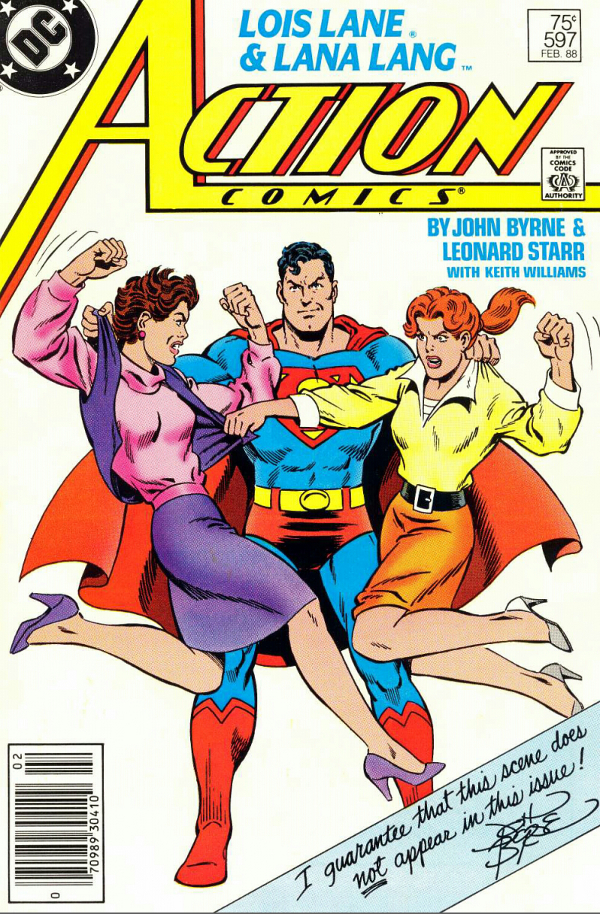 “Lois Lane and Lana Lang in ‘Visitor’” is the last story we are going to read here. Like the two previous ones, it was also created by comics writer-artist John Byrne. Although in the previous comics story we examined, Lois Lane is represented opposite newcomer Cat Grant, her traditional antagonist for Superman’s attentions is redhead Lana Lang, who, in this continuity, as Superman’s childhood friend, knows his secret identity.
 But on the cover of this story, that traditional antagonism between the two women becomes almost a fight. From a feminist point of view, although the two women seem the most active participants in the image, actually, their efforts come to nothing because Superman stops them, and on top of that, supposedly he is the reason for the fight, the final prize. Thus, Superman looks straight into viewers’ eyes with a sardonic expression emphasized by his arched brow and mocking smile. He seems to connect directly with his male implied readers and say, “What can you expect from these two females?”
However, we have to be careful with swift conclusions, because according to Byrne, this scene is not real. In what seems to be a surrealist statement taking its cue from Belgian artist René Magritte’s painting The Treachery of Images, with the image of a pipe and the caption “This is not a pipe,” Byrne includes a warning in the lower right-hand corner of the cover stating, “I guarantee that this scene does not appear in this issue!” Sure enough, although both women play a part in the story, the mood has nothing to do with the angry quarrel represented on the cover. What is more, this story lacks all the usual trappings of a superhero story ––near-death battles in the middle of desolate cityscape destruction. This story does not even take place in Metropolis, but in Smallville, since the title itself, “Visitor,” refers to the visit Lois Lane pays Lana Lang in her hometown in order to clarify some events that occurred in previous comic-book issues. Nevertheless, this may be a case belonging in a category called “indirect sexism” ––gender discriminatory actions difficult to classify as sexist because they are masked by certain strategies. Here the strategy is the statement that this is an imaginary scene that never happens in the story, but one thing is certain: imaginary as it is, it has been published on the cover.
-
Here you can assess this online comics reading club and help me improve it with your comments and evaluation.